Smart Solutions for Smarter Businesses

Your Trusted Partner, Now New
More Powerful Than Ever.

Contact us

Industry 4.0

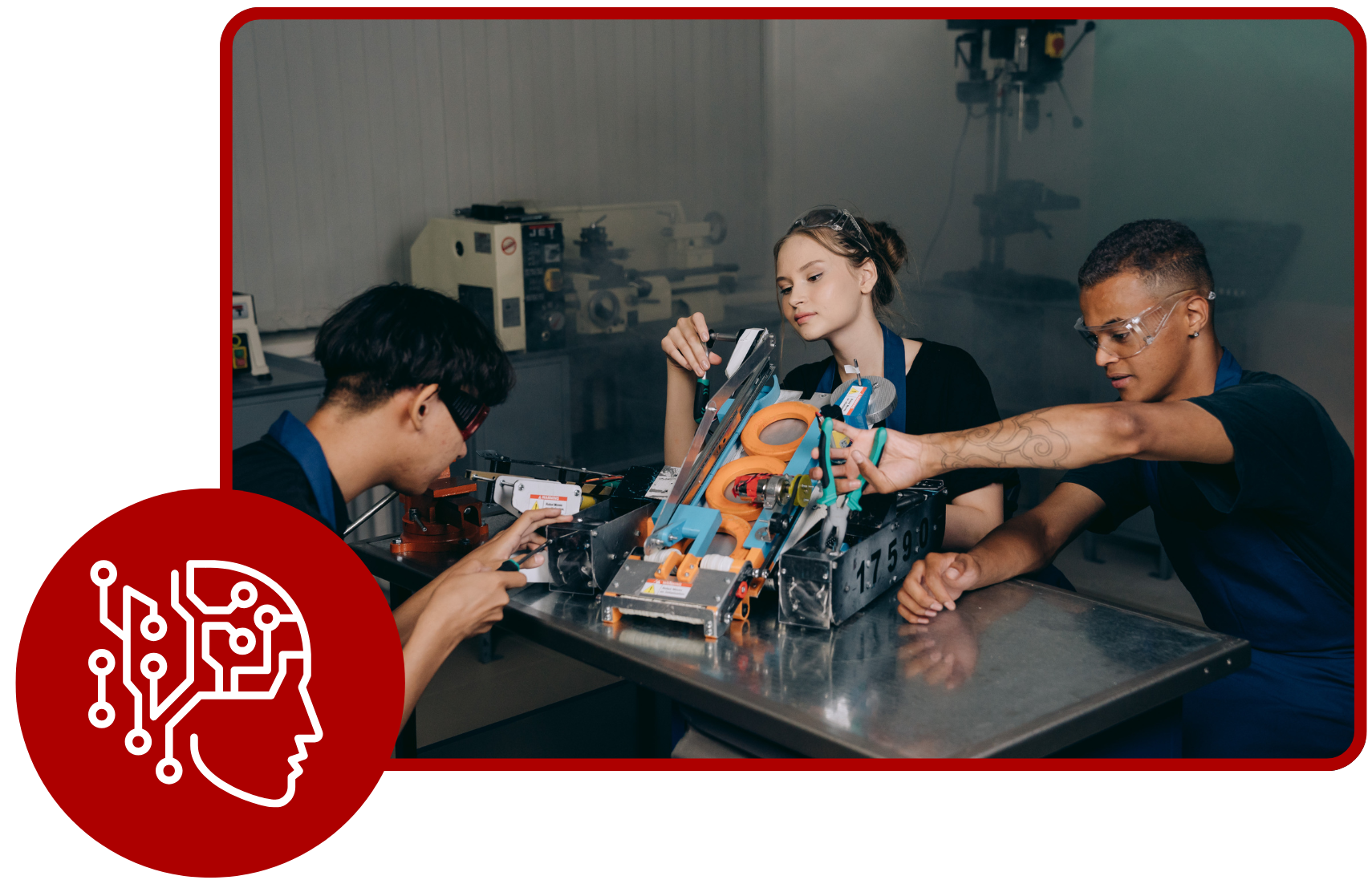
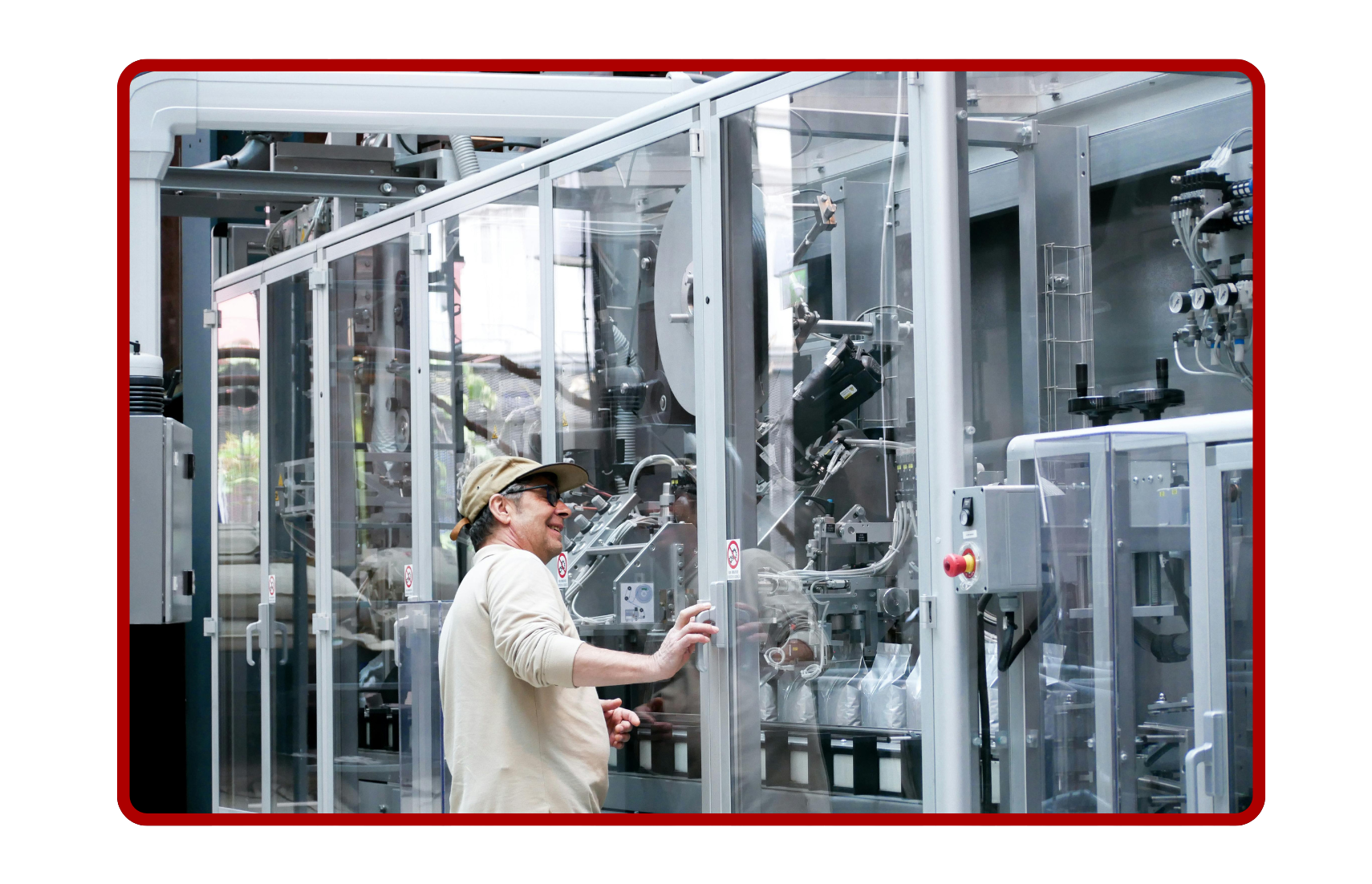
Industry 4.0, also known as the Fourth Industrial Revolution, is the current trend of automation and data exchange in manufacturing technologies. It includes cyber-physical systems, the Internet of Things, cloud computing and cognitive computing. These technologies are used to create smart factories, which are more efficient, productive, and flexible than traditional factories.!

Let's Connect
Industry 4.0

What is Industry 4.0 ?

“The Industry 4.0 train is leaving the station –Companies must decide when the best moment for them to hop on it”


01

The term Industry 4.0 encompasses a promise of a new industrial revolution —one that marries advanced manufacturing techniques with the Internet of Things to create manufacturing systems that are not only interconnected, but communicate, analyze, and use information to drive further intelligent action back in the physical world.

02

Industry 4.0 is disrupting the manufacturing on multiple fronts – from production throughput, maintenance and quality, to supply chain and inventory management.

03

This disruption is significantly changing the mindset of the current industrial ecosystem, by the use of Industrial IOT and automation in the processes and systems has ushered a favorable transformation in the world of manufacturing.

04

Industry 4.0 enables real-time access to data across the value chain by connecting people, machines, and systems. This integration creates dynamic, self-optimizing processes that improve efficiency based on cost, availability, and resource consumption.

05

Industry 4.0 integrates technologies like AI, machine learning, cloud computing, and cyber-physical systems to enable smart factories—where machines can make decisions, predict failures, and adapt in real-time to changing demands.

06

Through digital twins, augmented reality, and advanced analytics, Industry 4.0 empowers manufacturers to simulate production, reduce downtime, and enhance product customization—all while minimizing costs and increasing agility.


COMPONENTS OF INDUSTRY 4.0

Sensors and IOT

Sensors and IOT can be installed inside/on machine and workstations to providing benefits such as :

  • Direct and accurate information of the shop floors and industries.
  • Better tracking of ongoing operations without the need of any personnel
  • Real Time alerts of anomalies to prevent quality defects and machine/tool breakdowns
Sensors and IOT

Cloud Computing

  • It brings the powers of new age technology of connecting everyone everywhere everytime to the industries.
  • Maintaining and monitoring data over cloud servers provide even more ease than before to access information from anywhere at anytime
  • Using cloud technologies, approvals and sharing reports setting targets becomes more easier.
  • Remotely monitoring the industrial operations to ensure operational parameters are at optimal levels
Cloud Computing

Artificial Intelligence and Machine Learning

  • Data collected from shop floor, machines and various information systems like EMS, analysed and crunched using ML algorithms provide insights never available before.
  • Artificial Intelligence methods provide predictive alerts and notifications on capacities and unforeseen wastages.
  • Production Planning using ML and AI becomes more accurate and sustainable as system always keeps improvising from the live data being captured
Artificial Intelligence and Machine Learning

Process Automations

  • Using the powers of Industry 4.0, industrial processed such as production, inventory reconciliations, quality checks, dispatch ready checks, etc all can be replace by automated systems.
  • Automated systems and operations ensures the sustainability of the optimal performance and standards as human errors are avoided and also systems in place keeps the instructed checks always in place
Process Automations

EMPOWERING YOUR INDUSTRY THROUGH TECHNOLOGY

EMPOWERING YOUR INDUSTRY THROUGH TECHNOLOGY

  • Improve Overall Equipment Effectiveness and Manufacturing efficiency.
  • Ease in identifying Bottlenecks in operations
  • Achieving Production optimization.
  • Improve visibility through remote monitoring with real-time alerts.
  • Enhancing Shop floor Communication through the “Go the Gemba”

ENSURING QUALITY

  • Real-time monitoring alerts for Quality Checks.
  • Transformation from Conventional Quality to Predictive Quality
  • Improvising & Sustaining quality standards

EFFECTIVE & ON-TIME MAINTENANCE

  • Transformation from Preventive Maintenance to Predictive Maintenance.
  • Reducing unplanned downtime
  • Improving machine optimal performance

TRACEABILITY OF INVENTORIES

  • Real-time monitoring of available raw material & spare parts.
  • Automated & Accurate reconciliations of inventories
  • Tracking movement & utilization of raw material , components and finished goods.
  • Ensuring smooth supply-chain through guided production planning systems

KEY BENEFITS OF INDUSTRY 4.0

IT EMPOWERS YOUR SHOP FLOOR

Accountability
Communication Gap & Delays will reduce
Performance accuracies & monitoring of team & individual
Sustainable process optimization & monitoring
Improve manufacturing efficiency
Reduce production waste for increased profits
Gain Real-time shop floor visibility
Alerts Shop-floor workers with instant notifications
Improve operator engagement and overall company communication.

Perfect Performance with TPM

Perfect Performance with TPM

Total Productive Maintenance (TPM) is a maintenance philosophy aimed at eliminating production losses caused by equipment issues.
In simple terms, TPM focuses on keeping equipment operating at maximum capacity, producing expected quality products, and ensuring no unscheduled stops.
In essence, TPM is a system for optimizing maintenance and achieving perfect production efficiency.

Main Goals of TPM

  • No short stoppages or sub-optimal production rates
  • No defects
  • No unplanned downtime
  • No accidents

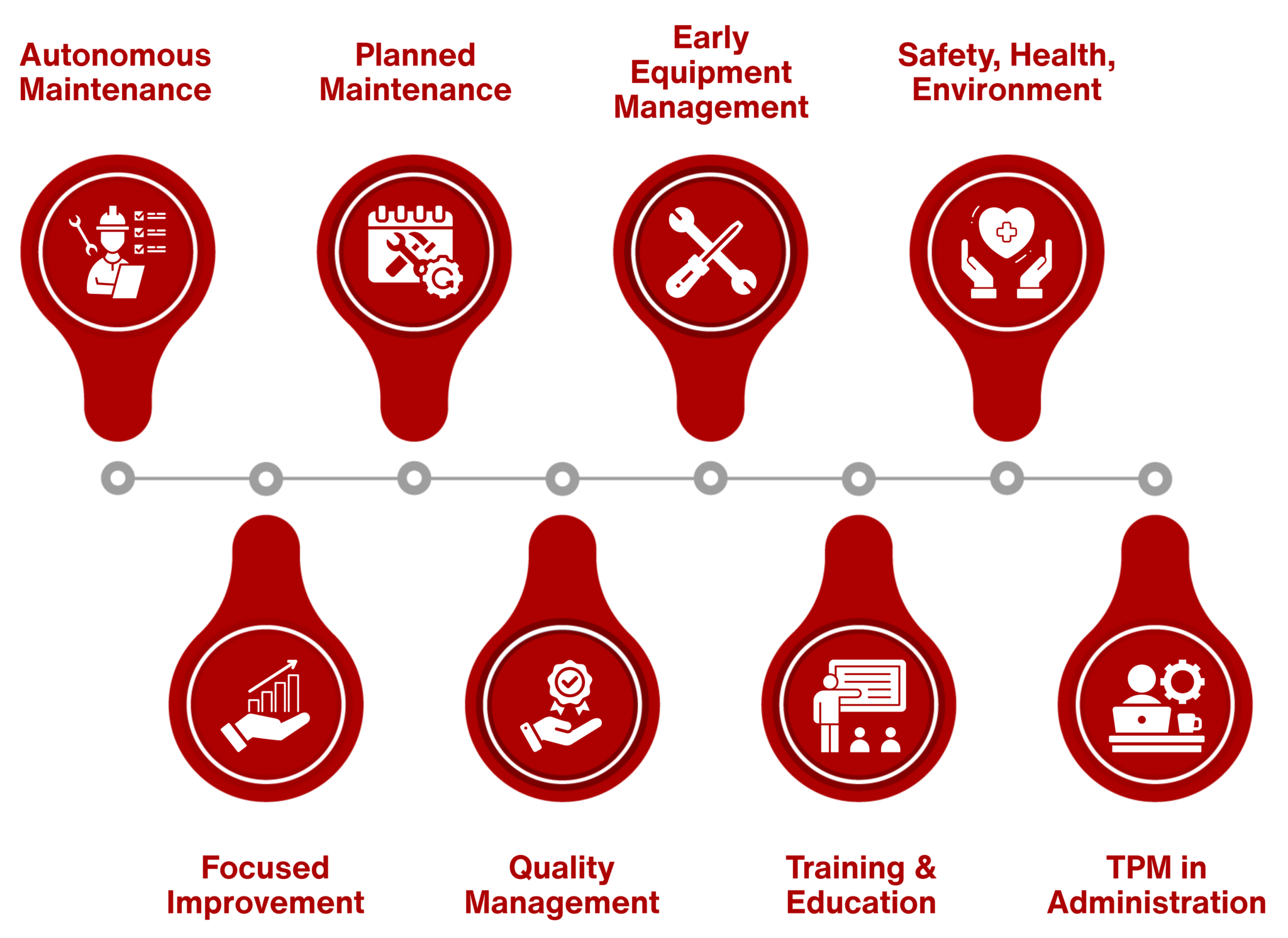
8 Pillars of TPM

TPM is built on an 8-pillar approach, covering every aspect of industrial maintenance.
These pillars aim to eliminate the Six Big Losses in production and enhance equipment performance.
With the rise of Industry 4.0, TPM integrates advanced technologies such as Machine Learning and IoT to further enhance maintenance efficiency.

Modern Enhancements with Industry 4.0

  • Predictive Maintenance: Using Machine Learning for ‘Just-in-Time’ maintenance.
  • Predictive Quality: Real-time data and ML-driven Root Cause Analysis.
  • Process Optimization: Maximizing production throughput by preventing process disturbances.
  • Remote Monitoring: Gaining insights into equipment performance to maximize Overall Equipment Effectiveness (OEE).

Six Big Losses

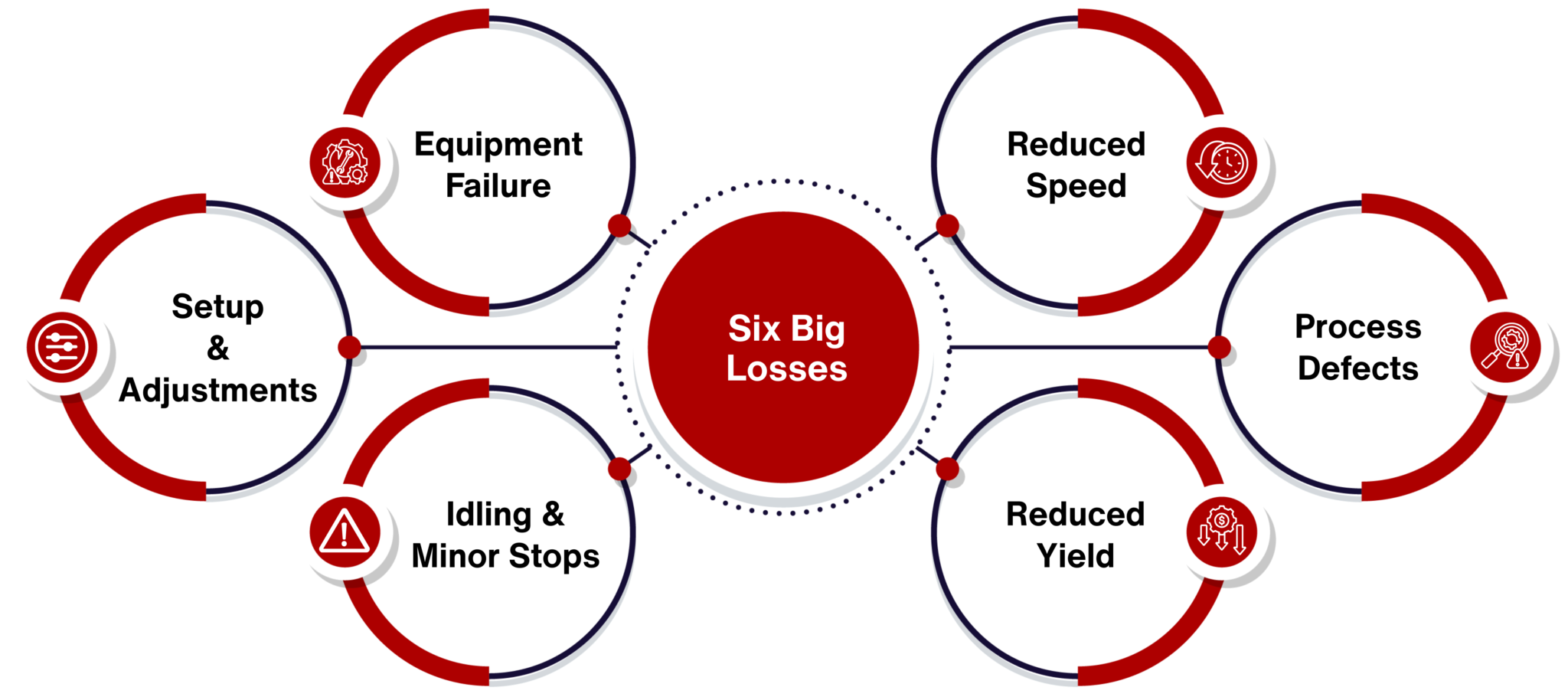
The Six Big Losses framework identifies inefficiencies in production that directly impact profitability.
These losses are closely linked to Overall Equipment Effectiveness (OEE) — reducing them leads to improved operational efficiency.

The Six Big Losses

  1. Equipment Failure (Unplanned Downtime)
  2. Setup and Adjustments (Planned Downtime)
  3. Idling and Minor Stops
  4. Reduced Speed
  5. Process Defects (Quality Losses)
  6. Reduced Yield (Startup Losses)

By addressing these losses, manufacturers can significantly improve their OEE scores and overall productivity.

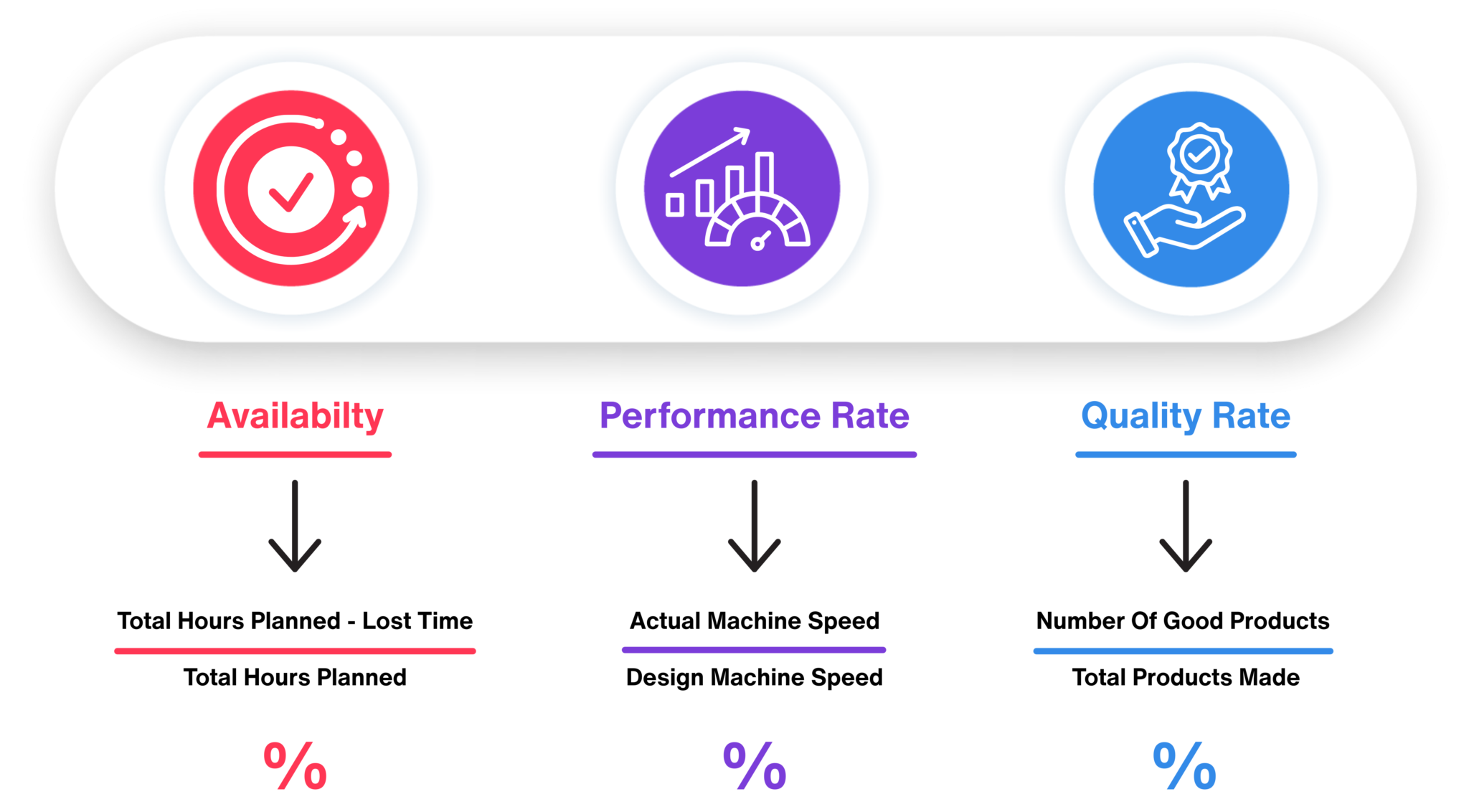
OEE = Availability x Performance Rate x Quality Rate

Overall Equipment Effectiveness (OEE)

OEE measures how well a manufacturing operation is utilized compared to its full potential during scheduled production time.
It identifies the percentage of manufacturing time that is truly productive.

An OEE score of 100% means:

  • You are producing only good parts (100% Quality)
  • As fast as possible (100% Performance)
  • With no stop time (100% Availability)

How OEE Helps

OEE provides a benchmark or baseline for measuring performance and tracking progress in eliminating waste from manufacturing processes.

Six Big Losses and OEE loss categories

OEE

oee

OEE Loss Categories

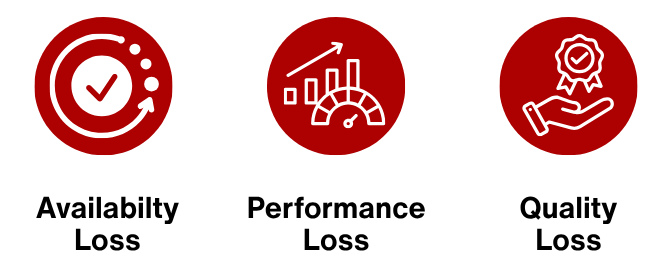
1. Availability Loss

  • Unplanned Stops: Unexpected equipment failures during scheduled operation.
  • Planned Stops: Scheduled stoppages such as setups or adjustments.

2. Performance Loss

  • Small Stops: Short interruptions (1–2 minutes) often resolved by operators.
  • Reduced Speed: Equipment running slower than its optimal cycle time.

3. Quality Loss

  • Production Defects: Defective parts produced during stable production.
  • Startup Defects: Defects generated during startup before stable production begins.

Need To Ask Questions ?

Contact Us